Skip to product information
1 of 5

I Could Be Meaner - Unisex T-shirt

2 total reviews

Regular price $21.99 USD
Regular price Sale price $21.99 USD
Sale Sold out

Renaissance elegance meets female empowerment. 

Color
Size
Quantity

In stock

  • Save 10% when you buy any 2 Tees
  • Save 15% when you buy any 3+ Tees
  • Free Shipping on orders $75+
  • Orders typically arrive in 7-10 days with flat-rate shipping

Returns

  • 30-Day No Hassle Returns
  • Free Return Shipping
  • Merchandise returned in good condition will be donated to Blanchet House

Product Details

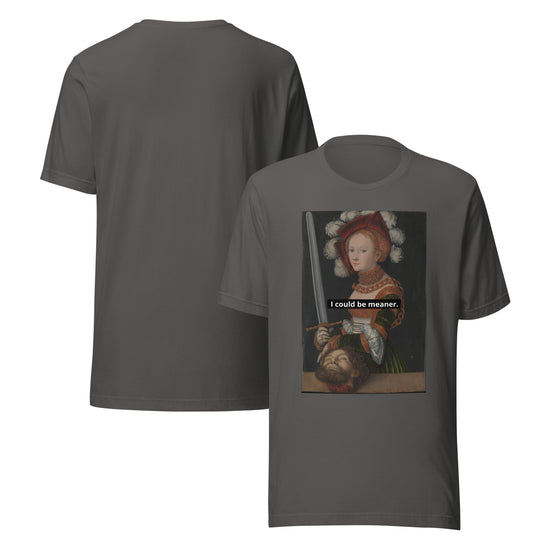
For those with a defiant style, this t-shirt features Lucas Cranach the Elder’s Judith with the Head of Holofernes (c. 1530), paired with the caption “I could be meaner.” 

• 100% combed and ring-spun cotton (Heather colors contain polyester)
• Pre-shrunk fabric
• Printed direct to garment for an instant lived-in feel without peeling or cracking

Sizing and Fit

Fits true to size. Order 1 to 2 sizes up for an oversized look.
Size guide
  LENGTH (inches) WIDTH (inches) CHEST (inches)
XS 27 16 ½ 31-34
S 28 18 34-37
M 29 20 38-41
L 30 22 42-45
XL 31 24 46-49
2XL 32 26 50-53
3XL 33 28 54-57
4XL 34 30 58-61

About the Artwork

'Judith with the Head of Holofernes' by Lucas Cranach the Elder (c.1530)


The story of Judith and Holofernes comes from the Book of Judith, where a Jewish widow named Judith saves her besieged city by outsmarting the Assyrian general Holofernes. After watching her people face starvation under his military blockade, Judith devises a plan: she dresses in her finest clothes, enters the enemy camp, and gains Holofernes’ trust with charm, confidence, and strategic flattery. Once he becomes drunk at a private banquet and collapses, she seizes his own sword and beheads him, carrying the head back to her people as proof of his downfall. The Assyrian army panics when they learn their leader is dead, and Judith’s bold act turns the tide of the conflict.

Art is subjective, but we’re all about mixing art history with modern themes. This painting is generally regarded by art historians to represent female empowerment. The contrast between her beauty and her violence is a reminder not to judge someone's capability by looks alone.

View full details